
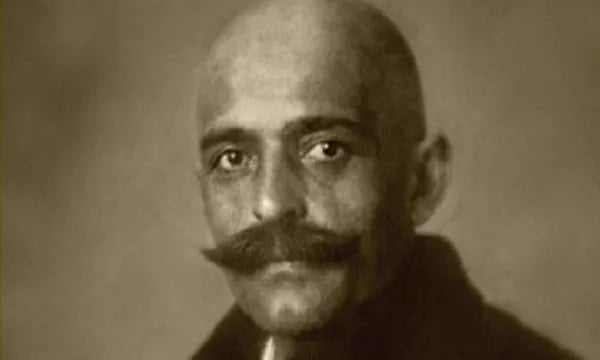
George Ivanovich Gurdjieff
A teacher of dance...
Beginning in 1912 in Russia, George Gurdjieff brought a unique spiritual teaching to the West. What we know of Gurdjieff's early life is based on what he chose to tell. After he began meeting with groups in Russia, numerous writers have described their time in his presence. Other anecdotes have been transmitted through those who knew him and carried on his teaching.
What is clear is that Gurdjieff traveled widely and devoted his life to understanding the human condition and our place in the universe. He relentlessly pursued means of effectively communicating that understanding to others, until his death in 1949. The Gurdjieff International Review, available on-line at the link below, is an excellent source for biographical details and elements of his teaching


The Laboratory of the Everyday
This is a practical method of self-study lived in ordinary life. Through shared efforts in quiet meetings and practical work, we learn to maintain a double attention—directed both outward to our tasks and inward to our state of being.
Working together in a structured local community provides the necessary friction to sustain this attention when habitual patterns would otherwise reclaim us.
To awaken is to realize that we are asleep, and that our ordinary life is lived in a state of reaction. The first step toward freedom is impartial self-observation.
A principle of the Fourth Way
Gurdjieff Group of Central New York
A practical path, exploring our human possibilities
© 2026 Gurdjieff Group of Central New York-An associate group of the Gurdjieff Foundation.
Active verification through direct experience